


6 min read
If you've ever wondered whether the bandwidth your business is paying for truly fits your business needs, you're not alone. Many IT leaders and business owners struggle to determine whether their current connection is too slow, or simply driving up unnecessary costs. As soon as employees begin to experience slow applications or dropped video calls, the instinct is often to upgrade to a faster internet package. However, the real problem may not be your business’s internet speed, but rather that your internet connection was not designed to support your evolving business operations.
What was once used primarily for email and web browsing has now become the backbone of modern business operations. Employees today are simultaneously accessing cloud applications, joining video meetings, collaborating across locations, transferring large files, and using AI-powered tools; all activities that create new demands on your network. These evolving needs often reveal the true limitations of your current setup.
With organizations continuing their shift to the cloud, reliable connectivity has become more important than ever. Despite this evolution, many businesses still rely on internet connections designed for an earlier era, resulting in performance bottlenecks that aren't always solved by simply purchasing more speed. That's why choosing the right internet connection goes beyond just considering bandwidth. It means understanding exactly how your business uses the internet, identifying where bottlenecks occur, and assessing whether your current service is truly equipped to support today's workloads.
Before upgrading your internet plan, take a step back and ask yourself: Does your connection truly fit the way your business operates today?
Modern businesses no longer use the internet for just one task at a time. Instead, nearly every department now depends on a steady flow of data throughout the workday. Sales teams meet with customers via video calls, employees access cloud-based platforms, marketing uploads large files, IT manages security tools, and AI applications continuously exchange information in the background. In essence, your internet connection has become the backbone of your entire business.
Today’s networks must support critical activities including:
- Powering Microsoft Teams meetings
- Keeping VoIP phone conversations clear and reliable
- Syncing files to the cloud
- Supporting remote employees
- Running business-critical applications
- Supporting AI-powered tools that continuously exchange data
Microsoft Teams alone has become a cornerstone of daily business communication, with more than 300 million monthly active users worldwide. As real-time collaboration becomes the norm across organizations of all sizes, networks must be able to support uninterrupted communication. However, supporting these applications requires more than just having an internet connection; it demands sufficient bandwidth to manage the constant flow of data both up and down across your network.
What Is Bandwidth?
To understand your business’s internet needs, it’s important to begin with the basics: bandwidth. Bandwidth refers to the maximum amount of data your internet connection can transmit at any given moment. Think of it as the number of lanes on a highway. When traffic is light, vehicles move freely, but as more cars merge onto the road, congestion builds. Eventually, everyone slows down; not because the vehicles themselves have changed, but because there simply isn’t enough space for all of them to move at once.
This analogy directly reflects how your business network operates. Every employee represents another car on the road, and each Teams meeting, VoIP call, cloud application, security camera, AI assistant, or file transfer adds to that traffic. As your organization grows and adopts new technologies, your network must handle an increasing volume of simultaneous activity. Often, these changes happen gradually; a new employee joins, a department adopts cloud software, meetings shift online, and larger files are shared. Over time, a connection that once worked flawlessly can become overwhelmed by a workload it was never designed to support.
The Hidden Challenge: Asymmetrical vs. Symmetrical Internet
Having sufficient bandwidth is only part of the equation. How that bandwidth is allocated is just as important. Historically, many organizations have implemented asymmetrical internet connections, where download speeds greatly surpass upload speeds. This arrangement was logical when most internet activity focused on consuming information. However, as workplaces have shifted to the cloud, the need for balanced performance has become essential.
When upload speeds lag behind demand, productivity suffers as bottlenecks arise. Imagine a typical Monday morning: sales teams are on customer calls, marketing is uploading presentations, accounting is working in cloud-based software, customer service is assisting clients, and several employees are joining Teams meetings; all vying for the same limited upload bandwidth. This is when video freezes, calls drop, and employees blame the WiFi, even though the true issue lies with an outdated, asymmetrical internet system.
To resolve these challenges, more organizations are investing in symmetrical bandwidth, where upload and download speeds are equal. While the difference may not always be apparent in faster website loads or instant downloads, increasing your upload speed, such as moving from a 20 x 10 Mbps to a 20 x 20 Mbps connection, doubles the amount of data your business can send at once, which can dramatically improve everyday operations. With this added upload capacity, critical business applications run more smoothly, eliminating internal competition for bandwidth. The benefits are clear: Virtual meetings are more reliable, VoIP calls are clearer, cloud backups finish faster, and employees collaborate without frustration. Ultimately, the objective is not just to boost speed but to achieve the optimal balance of speed and capacity for your business.
How Much Bandwidth Does Your Business Need?
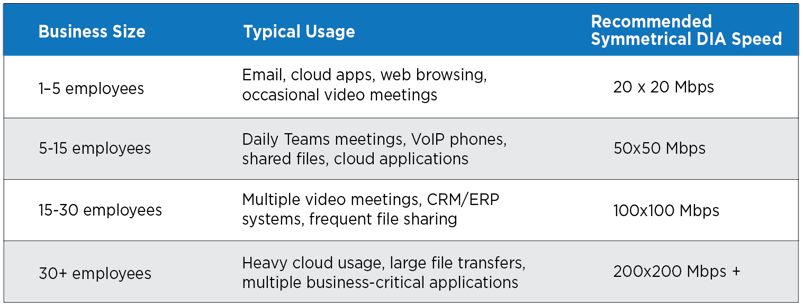
Every business is unique, but the guidelines below offer a helpful starting point.
The right bandwidth depends on far more than employee count. Businesses that frequently transfer large files, rely heavily on Microsoft Teams, operate across multiple locations, or use cloud-based business applications often require more capacity than organizations of a similar size.
Beyond Bandwidth: Why Reliability Matters Just as Much as Speed
While upgrading your bandwidth can resolve many performance issues, it’s crucial to remember that speed is only one part of the equation. A faster connection may enhance performance, but it doesn’t automatically guarantee a reliable network.
Several other factors; like poor WiFi coverage, outdated networking equipment, overloaded firewalls, inefficient traffic routing, or a lack of backup connectivity, can all impact your network’s reliability as well, no matter how much bandwidth you have. It’s similar to adding more lanes to a highway while neglecting faulty traffic lights; the extra capacity helps, but it won’t fix every obstacle slowing down the flow. That’s why it’s essential for businesses to evaluate their entire network environment when considering an internet upgrade.
When assessing connectivity options, businesses must look beyond bandwidth alone. Reliability, backup connectivity, Service Level Agreements (SLAs), security, and technical support all play a critical role in keeping operations running smoothly. Ultimately, the best internet solution isn’t simply the one with the fastest speeds; it’s the one that delivers the right blend of performance, reliability, and support for your business.
Why Businesses Choose Telesystem Dedicated Internet Access
For organizations that depend on their network to keep business moving, a dependable connection is essential. That’s where a business-grade solution like Telesystem Dedicated Internet Access (DIA) can truly make a difference.
If bandwidth is the highway, Telesystem DIA gives your business its own dedicated lane. Unlike shared internet services, such as GPON or broadband, DIA provides a connection reserved exclusively for your organization, ensuring consistent performance even during periods of peak usage. With symmetrical upload and download speeds, Telesystem DIA offers the capacity needed to support the applications businesses rely on every day, without worrying about bandwidth bottlenecks.
Furthermore, Telesystem DIA is designed with business continuity in mind. With scalable bandwidth options, built-in DDoS protection, robust Service Level Agreements (SLAs), and 24/7/365 U.S.-based technical support, businesses gain both the reliability and assistance they need to keep teams connected as demands evolve.
Finding the Right Internet Solution for Your Business
As cloud applications and hybrid work continue to drive network demand, businesses require more than just an internet provider; they need a technology partner who can help them plan for the future, eliminate bottlenecks, and build a network that’s ready for what’s next. If you’re unsure whether your current internet service is meeting your business needs, Telesystem can help. Our experts take the time to understand your users, applications, locations, and business goals before recommending a solution.
Whether your organization needs symmetrical bandwidth, Dedicated Internet Access, LTE backup, SD-WAN, managed networking, or security solutions, our goal is to deliver the right balance of performance, reliability, and value. The best internet connection isn’t always the fastest one; it’s the one that’s truly built for your business.
Learn more about Telesystem’s advanced networking solutions at https://www.trusttelesystem.com/network
Related Posts
How can big data improve customer experience
The days of mad men sitting around deciding on the next big ad simply based on what they think is...
What is SD-WAN?
SD-WAN was only introduced to mainstream networking practices in 2014 when the term was first...
Why Wi-Fi location analytics can lead to more efficient retail operations
Location services are among the most powerful capabilities of mobile devices, enabling every use...